Go-To-Market Consulting for Life-Science and Diagnostics Companies
From product to pipeline.
Emerging life-science and diagnostics companies reach a commercialization inflection. The science is validated, early traction exists, and the next move is a structured push into market. That move isn't just a campaign. It's a coordinated go-to-market motion: positioning, ICP definition, messaging architecture, channel strategy, integrated campaigns, and the marketing operations layer underneath. Higgins Beach Marketing builds and runs that motion end-to-end; evidence-led, ROI-architected, purpose-built for narrow-market B2B verticals.
A recent engagement: a revised go-to-market strategy for an underserved commercial laboratory segment. Work included establishing ICPs, identifying value propositions, customer journey mapping, revising pricing and programs, building bespoke digital campaigns, and creating sales enablement tools — a single integrated marketing program that produced a new-business pipeline within months.
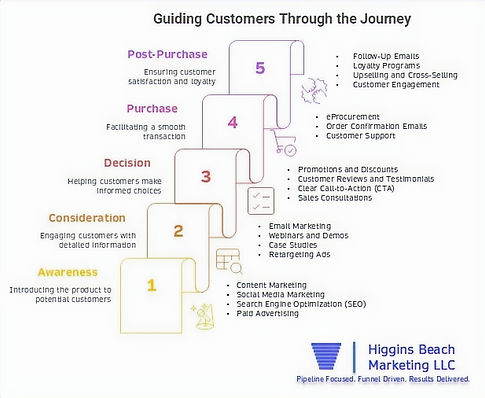
Every GTM Engagement Starts with the Customer Journey
Positioning, campaigns, and pipeline outcomes all start with a clear map of how the customer actually buys. That map is the foundation of every HBM engagement — not a slide at the end of the deck, but the decision layer that sets the ICP, the channel mix, the messaging architecture, and the attribution model.
Capability Stack. GTM, ABM, Marketing Operations
The full go-to-market capability stack delivered from a single operator — strategy through execution, not handed off between three consultants.
GTM Strategy - The Foundation Layer
Positioning and ICP definition. Value proposition and messaging architecture. Customer journey mapping. Competitive analysis and market feasibility. 30-60-90 day launch and expansion plans. GTM strategy workshops that leave the client team equipped to run the motion themselves.
Fits:
• New product launches
• Market entry and segment expansion
• Re-positioning engagements against shifting competitive landscape
ABM & Integrated Campaigns — The demand layer.
Account-based marketing programs tuned for narrow, relationship-driven verticals. Integrated multi-channel campaigns — digital prospecting, SEO, email automation, webinars, organic and paid social. Campaign-specific landing pages wired to attribution. Ongoing campaign management available as a monthly retainer or scoped project build.
Fits:
• Pipeline creation in low-volume, high-value B2B segments
• Named-account campaigns against a defined target list
• Integrated launches pairing ABM with broader demand-gen motion
Marketing Operations — The measurement layer.
Marketing automation setup and training. CRM and MarTech implementation, optimization, and integration into the commercial operating cadence. Attribution, pipeline signal, and analytics wired in from week one. Cross-functional alignment between sales and marketing — shared metrics, shared pipeline accountability, shared sales-enablement tooling.
Fits:
• Teams instrumenting marketing for the first time
• Engagements where pipeline signal needs to be measurable, not anecdotal
• Sales-marketing alignment projects with shared-metric deliverables
Evidence-Led, ROI-Architected
Every HBM engagement runs on evidence. Campaigns measured at the attribution layer, pipeline at the account level, spend at the ROI horizon — not because dashboards are fashionable, but because commercialization dollars in an emerging life-science or diagnostics company are too scarce to spend on intuition. Evidence-led means the marketing engine gets instrumented at week one, not year one.
ROI-architected means every campaign, channel, and automation ties back to a pipeline outcome the team can defend to the board. It also means HBM reads both sides of the data stack — the scientific data that validates the product, and the commercial data that validates the market. Most fractional leaders live on only one side of that stack; most technical consultants live on the other. HBM reads both with the same literacy.
"Turning data into dollars"
From Product to Pipeline
A typical GTM engagement runs from product-side foundation work to pipeline-side execution in three overlapping phases. Scope, pacing, and handoff vary by engagement; the shape is consistent.
01 — Foundation (Weeks 1–4)
Positioning audit, ICP definition, value proposition work, competitive landscape scan, customer journey map. The science comes in; the commercial frame comes out.
02 — Build (Weeks 5–10)
Campaign architecture. Automation setup and CRM integration. Enablement materials and landing pages. Channel mix scoped, budgeted, and wired to the attribution layer. The execution machinery goes live.
03 — Pipeline (Weeks 10+)
Campaigns running in market. Pipeline signal landing against named accounts. Attribution working. Handoff to the internal team, or continued retainer engagement with HBM owning the measurement cadence.
If you're an emerging life-science or diagnostics company preparing a launch, re-entering a segment, or building the commercial machine behind validated science, book a commercialization conversation.
Download the GTM/Integrated Marketing Things to Consider Checklist by filling out the form below.